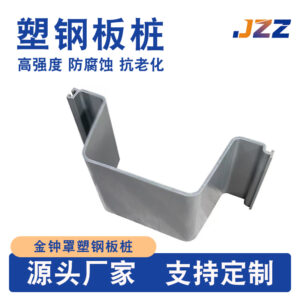
Plastic steel sheet piles realize water sealing by forming a continuous retaining wall through interlocking lock joints. The concave and convex locks on both sides of the piles are inserted and fastened with each other, forming a tortuous seepage passage after adjacent sheet piles are embedded. The zigzag channel greatly increases seepage resistance and weakens the penetration of groundwater. Sealing materials can be filled inside the locks to further block gaps and prevent water and soil leakage at the joints, forming an integral anti-seepage supporting wall.
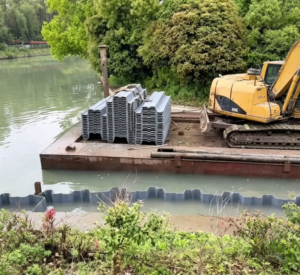
In revetment engineering, the water-stop effect primarily depends on the lock condition. All incoming piles shall be inspected for deformation and damage. Distorted locks will cause excessive gaps after assembly and lead to water seepage. During piling, the verticality of sheet piles must be strictly controlled. Inclined piles will cause lock dislocation and open joints, forming hidden seepage channels.
Thorough cleaning of lock joints is another essential procedure. Silt and gravel remaining in the concave-convex grooves will prevent tight fitting of locks. All impurities inside the locks must be cleaned before construction to ensure complete embedding. For river revetments with high water levels, sealing fillers can be injected into lock gaps to enhance anti-seepage performance.
Continuous and closed construction of the whole wall is the core guarantee of revetment water stoppage. Broken piles and gaps are not allowed in the sheet pile wall. Special-shaped piles at corners are critical, as poorly interlocked corner joints are the main leakage positions. Reasonable piling sequence shall be adopted to avoid displacement of finished piles caused by construction disturbance.
Regular monitoring is required after construction to check lock seepage during water level fluctuation. The overall anti-seepage effect of revetments depends not only on pile quality, but also on lock integrity, piling verticality, joint cleaning and construction quality of corner parts.