Plastic-steel sheet piles feature excellent corrosion resistance and simple modular installation. They are widely used in river regulation, landscape revetment and pond support projects. These sheet piles work well in loose and moderately dense soil layers, such as silt, silty soil, ordinary sand and soft plastic clay. However, limited by the stiffness and impact resistance of polymer materials, they cannot adapt to all geological environments. Improper use in harsh ground conditions may cause pile damage, lock failure, water leakage and wall instability. Therefore, these risky conditions must be avoided during design and material selection.
First, plastic-steel sheet piles are not suitable for construction in rock layers and highly weathered hard bedrock. Rock strata are extremely hard and create strong driving resistance. It is difficult to press or vibrate sheet piles to the designed depth with conventional equipment. Forced construction will crack the pile tip, deform the pile body and damage interlock structures. As a result, the wall will lose its waterproof performance and continuous supporting capacity. Even scattered shallow boulders and hard rock blocks will block pile driving, cause pile inclination and misalignment, and greatly increase construction failure risks.
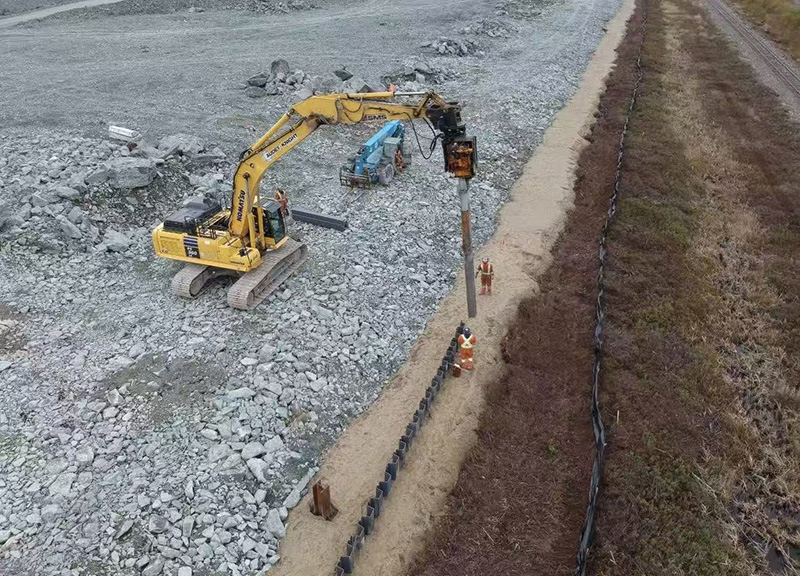
Second, thick cobble, gravel and large boulder strata are not ideal for direct installation. Large amounts of gravel and scattered boulders will scratch and hit the pile body and interlock joints. This destroys the sealing effect and forms hidden water seepage channels. Hard stone also creates local stress points, which easily damage the sheet piles. For strata with large and densely distributed stones, direct piling is not recommended. If sheet piles must be adopted, pre-drilling and obstacle clearing are required, which will greatly increase construction costs.
Third, extremely dense stiff clay and hard clay layers are not suitable for direct construction. Such soil layers have high hardness and strong penetration resistance. The huge piling resistance will prevent the sheet piles from reaching the designated depth and easily cause bending deformation. In addition, hard clay expands and shrinks with humidity changes, which produces repeated squeezing pressure on the pile wall. Polymer materials are prone to creep deformation under long-term stress, which will gradually deform the sheet piles and reduce the overall stability of the revetment structure.
Moreover, backfill sites with large amounts of hard underground obstacles are not recommended for plastic-steel sheet pile construction. Underground concrete blocks, construction waste and hard residues will block piling work, damage interlock joints, and cause wall dislocation and water leakage.
Besides geological conditions, project working conditions also need full evaluation. Plastic-steel sheet piles are only applicable for low and medium-height retaining structures. They are not suitable for ultra-high revetment walls or projects with heavy backfill loads due to insufficient material rigidity.
In the early stage of engineering design, a complete geological survey is essential to clarify soil composition, stone distribution and soil compactness. For the above unfavorable geological conditions, steel sheet piles or concrete retaining walls are better alternatives. If plastic-steel sheet piles are still required, construction teams must conduct pilot hole drilling, soil pretreatment and professional structural verification. Blind piling is strictly prohibited to ensure long-term engineering safety and stability.